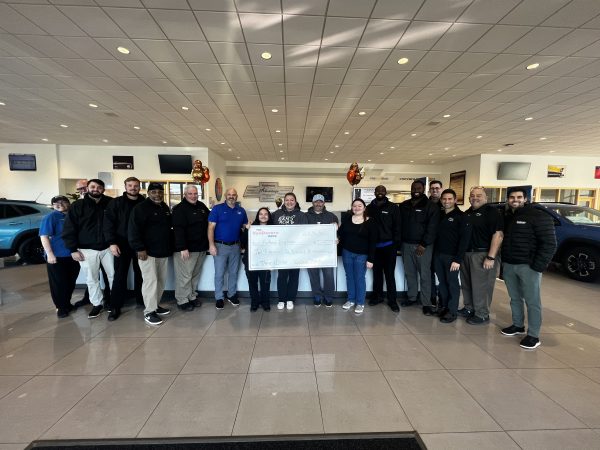
The iPad Giveaway is back!

“Like” us on Facebook and enter for a chance to win an iPad 2!


The instructions are simple:

  • Now through April 29th visit our Facebook.
  • Click on the Shamrock symbol beneath our profile picture.
  • Click “Enter Sweepstakes” and fill out the form.

OR

  • Stop in any of the 4 locations.
  • Fill out a Marketing Survey Card.

The final drawing will take place on April 30, 2012. See complete rules and restrictions. Good luck everyone!

2012 Detroit: Stuff Your Ballot Boxes for the Chevrolet Code 130R Concept

Written by: Todd Lassa on January 11 2012 7:10 AM

Chevrolet-Code-130R-Concept-front-three-quarter-1

UPDATE: Chevrolet public relations suggests you register your opinions of its two concepts at facebook.com/chevrolet or on Twitter @chevrolet


DETROIT — Call, write, email, tweet Chevrolet right now and tell them you want the Code 130R. The red one. GM’s advanced design chief, Clay Dean, says the vote so far is overwhelmingly for this rear-drive car over the Cruze-based Tru 140S, the white car, which frankly (my opinion, not his) looks like a Mitsubishi Eclipse. These are the two Chevy concepts GM is showing to young people to gauge interest and build a business case. The red car’s designer, Joe Baker, worked for Ford, where he designed the 427, Interceptor, and Bronco concepts. Although the company applied some of his design cues to front-drive cars, Ford never produced his concepts, so listen up GM: Don’t let the red car or his designer get away.

2012 Detroit: Stuff Your Ballot Boxes for the Chevrolet Code 130R Concept image

Here’s why I chose the Code 130R as the most significant intro from the 2012 North American International Auto Show. It’s meant to be a $20,000 rear-drive coupe that can reach 40 mpg with a 1.4-liter Ecotec turbo four, and it’s based on the same Alpha platform as the Cadillac ATS, the next CTS, and the 2015 Camaro. It’s like a reversal of GM in the bad old days of Roger Smith, when it went to front-drive for most of its cars, including Cadillacs and Buicks. I don’t expect GM to switch back to RWD for most of its cars, nor should it. But it would be nice if the Alpha platform and a lightened Zeta II could accommodate a variety if cars of varying sizes and sticker prices, from Chevy to Buick to Cadillac to Holden and even Opel.

The millennial buyers get the Code 130R, Dean says, because they know drifting and they understand the handling advantages of RWD. So call or write GM and tell them you’d buy one. Mainstream buyers would get the 140-horse 1.4-liter Ecotec, though of course the 2.0-liter turbo Ecotec that makes 270 horsepower in the new Caddy ATS will fit. The red car is much more finished than the white Chevy concept, with door handles, a trunklid, and a hood line, and Dean says there’s a business case for it. Chevy could get it into production pretty quickly. It needs a new name. Call it “Corsa,” the name of a sporty Corvair from the ’60s, and used on a small Opel in Europe.

Read more: http://blogs.motortrend.com/2012-detroit-stuff-your-ballot-boxes-for-the-chevrolet-code-130r-concept-20417.html#ixzz1jpQAADgO

Chevrolet Design Center Comes to Disney World

Beginning this fall, Epcot guests will be able to enjoy a re-imagined version of the popular Future World attraction, Test Track presented by Chevrolet.

This new version of the attraction will transform the current testing workshop into the sleek “Chevrolet Design Center at Epcot,” where guests can become immersed in the fun – and fast – world of automotive design. Here, guests will become automotive designers and create their own custom vehicles. Next, they’ll buckle into a six-person SimCar ride vehicle and test out their design on the challenging track of the Test Track course.

Afterward, guests can take a fascinating look into the future of transportation by viewing a collection of the latest Chevrolet vehicles in an all-new showroom.

This fun new experience is the result of a renewed, multi-year business relationship between Disney and General Motors, companies that have worked together for more than 30 years.

Read more: http://disneyparks.disney.go.com/blog/2012/01/re-imagined-test-track-will-put-guests-in-the-designers-seat-this-fall-at-epcot/

Kia GT Concept

September 12, 2011
By Alex Nishimoto

Kia’s slow rear-wheel-drive concept striptease is finally over. We now have the full monty on the Kia GT Concept, which is debuting at the 2011 Frankfurt Auto Show. The Korean automaker’s first foray into rear-drive sports car design, the Kia GT is an ambitious effort from a company that has just begun to build exciting, design-centric cars.


The GT Concept, which no doubt is squarely aimed at the burgeoning four-door coupe market, is powered by a turbocharged, direct-injected 3.3-liter V-6 producing 390 hp and 394 lb-ft of torque. An eight-speed automatic transmission sends that power to the rear wheels, which stand 112.6 inches from the front wheels. At 184.6 inches long and 54.3 inches tall, the car’s low-slung stance and profile contribute to its sporty look.


From the get-go, the Kia GT’s design team wanted to ensure that the concept couldn’t be mistaken for anything but a rear-drive sedan. The results are an elongated hood, short front overhang, and bulging rear shoulders that emphasize the car’s overall cab-rearward design. For inspiration, Kia says it turned to 1970s-era GT cars, an influence that can be seen in the Kia GT’s truncated rear end. 

The car’s styling is also influenced by aeronautical design, with a vent-heavy front valance and concept-style, propeller-like wheels. The front end borrows slightly from the Kia Kee concept of 2007, with the lines of the large front intake vents molding into, and in this case, overlapping, the LED headlights. The wheels are a multi-piece design, and feature lightweight alloy and carbon-fiber construction. Carbon fiber also appears to be used heavily in the rear diffuser, which should help stabilize airflow beneath the car. In place of side mirrors, a pair of sleek, jet-age rearview cameras jut out of the front fenders like fins on an airplane.


Copper is yet another running theme with the Kia GT, as the metallic color recurs several times on the concept. Copper-colored trim is used to highlight the car’s sloping rear roofline, and flows from the A-pillar all the way to the bottom of the rear window. The brake calipers are also finished in copper. To accentuate these details, the glass used for the windshield and windows is tinted an equally shiny, but brighter, gold tone. 

Entry into the Kia GT’s cabin is made easier with the help of suicide doors and B-pillarless body construction. The front doors open conventionally, while the rear doors are rear-hinged and open out and slightly upward. Inside, the Kia GT seats four, giving each passenger their own one-piece bucket seat. Front seat occupants get metallic-treated leather seats in a golden-brownish hue, helping to tie the concept’s copper-tone theme together. This material is used throughout the cabin, and was chosen by Kia to create a warm, welcoming interior.


Kia describes the layout of the cockpit as driver-centric, and kept the number of buttons and controls to a minimum. From the driver’s seat, a glass instrument panel like the one used on the recent Kia POP concept is seen front and center, while a small, concave, tri-spoke steering wheel allows the driver to control the central data display with buttons within fingertip reach. A large red ignition button does double duty, also acting as an electronic gear selector knob, giving the driver the ability to start the car and put it in gear using the same control. To round out the Kia GT’s driving interface, small LED screens are placed on the inside of the front doors, displaying the view from the fender-mounted rearview cameras. 

Whether the Kia GT will make the jump from concept to production car is unclear. With 390 hp, a rear-drive layout, coupe-like styling, and a generally upscale interior treatment, the car could target other four-door coupes such as the Audi A7, Jaguar XF, and Mercedes-Benz CLS if produced. We can’t say whether Kia and its newfound styling mojo are ready to hang with the veterans of the segment, but given the Korean automaker’s quickening pace in the industry, we’d love to see it try.

Read more: http://www.motortrend.com/future/concept_vehicles/1109_kia_gt_concept/#ixzz1igk35yL5

The Case for the Autonomous Car

From the March, 2012 issue of Motor Trend

By Todd Lassa

Yes, you should be worried about Google testing autonomous cars. It has been testing driverless Toyota Priuses and other models since competing with General Motors and other teams in the Defense Advanced Research Project Agency’s autonomous vehicle demonstrations of the late 2000s. The ubiquitous computer search engine company has been reticent in talking about its project toMotor Trend, though The New York Times’ November 13, 2011, expose on Google X, the company’s research lab, reported that the autonomy project is part of a secretive effort to open and establish new markets and technologies.

“Unimpressed by the innovative spirit of Detroit automakers,” The Times reported, “Google is now considering manufacturing them in the United States, said a person briefed on the effort.”

One non-innovative Detroit automaker is experimenting with driverless cars too, though its efforts are more practical and palatable to those of us who don’t want to give up the wheel, throttle, and brakes, much less the gearbox. GM’s futurist, Chris Borroni-Bird, director of Advanced Technology Vehicle Concepts, says some form of autonomy will be on the road before the end of the decade.

“You can address some of the aging population trends by keeping a vehicle almost the way it is and making it autonomous,” Borroni-Bird says, “but in an urban context, you almost need to rethink what the automobile does, in terms of range and speed and key performance requirements, and what it looks like.”

The result so far is GM’s Segway-based EN-V bubblecar concepts, last year renamed as part of the Chevrolet brand. When such vehicles hit the road some time in the future, Borroni-Bird says, they’ll likely look much different, but they’ll work much the same. The Chevy EN-V is designed to be a small, electric car that could have one, two, three, or four wheels, one or more seats, and be part of a megacity’s car-sharing program.

EN-Vs will have top speeds in the 25-mph range to coexist safely with pedestrians, bicycle messengers, and other vehicles, and can get a quick recharge during the day, between ride-share customers.

“It does things a bicycle and walking can’t do, and it does things a bus or train can’t do,” Borroni-Bird adds. “It’s kind of swimming upstream against what people want. But we recognize that we can’t keep selling just the same type of vehicle we make today, that goes wherever you want to go, 70 or 80 mph for 300 miles, and carry five people.”

The technology involves global positioning systems and short-range communications antennas, necessary because the tall buildings that make up urban canyons can hamper GPS. Often, the cars will run in tandem like schools of fish. Because autonomously operated cars in theory won’t have accidents, they won’t have to carry heavy safety features like airbags and 5-mph bumpers.

GM has a memorandum of understanding to study incorporating Chevy EN-V tech into the Tianjin Ecocity, a joint development between Singapore and Tianjin, a megacity of 12.3 million people, and a 73-mile high-speed rail ride from Beijing. The Ecocity just outside Tianjin accommodates 350,000 people, Birroni-Bird says. “If we can make it work in that size city, it’s definitely scalable.”

That means dedicated EN-V lanes and roads, Borroni-Bird continues. “We’re looking at how to integrate the next-generation of EN-V, not this one, but the next generation, into that city. The core of EN-V is really a small-footprint vehicle that’s highly maneuverable, that’s battery-powered and has network and sensing capability, to allow manual and autonomous operation.”

I briefly drove one inside a GM garage, limited to no more than 5 mph. The bubble car is incredibly easy to use, fun to drive, and finally makes good use of the Segway technology Dean Kamen oversold a decade ago. Buckle up, start it, and the “car” rises up and balances on its two wheels. Pull the yoke to go forward, and pull on bars on the back of the yoke to brake. It has a 0-foot turning radius, of course.

“We know we’re not going to solve congestion,” Borroni-Bird says, “but if you can make the travel time more productive and more predictable, it’ll reduce the stresses associated with congestion.”

Read more: http://www.motortrend.com/future/concept_vehicles/1203_the_case_for_the_autonomous_car/#ixzz1icWbmhzN


Automakers vying for top honors at Detroit auto show

By Paul A. Eisenstein, msnbc.com contributor

It’s automotive award season, so expect to see a lot of commercials touting cars, trucks and crossovers that are “best” in one category or another.

But few trophies carry the heft and credibility of the one that will be handed out following the opening ceremony of next week’s 2012 Detroit auto show.

Unlike most automotive awards, the winners of the North American Car and Truck of the Year (“NACTOY”) are decided by a panel of 50 U.S. and Canadian journalists. The methodology is designed to make sure that no single media outlet’s editorial — or advertising — policies influence the verdict.

The widely regarded, and oft-quoted, NACTOY is something most manufacturers actively and aggressively seek, so even landing among the finalists is considered a major victory — or a serious setback if you’re left off the list.

And, for the first time in quite a while, there are no Japanese autos among the finalists for North American Car of the Year — a potentially significant development when the major Asian carmakers seem more vulnerable than they have been in decades.

The car-of-the-year finalists — the Ford Focus, the Hyundai Elantra and the Volkswagen Passat — are nonetheless an international bunch. But surprisingly absent are two particular models that would, in years past, have been absolute shoe-ins, at least for inclusion among the finalists: the 2012 remakes of the Honda Civic and the Toyota Camry.

The choice of an American, Korean and a German car “reflects the fact that every manufacturer is getting better these days,” suggested Joe Phillippi, chief analyst with AutoTrends Consulting. At the same time the Civic and Camry “certainly don’t break new ground,” he said.

They’ve both taken a fair share of criticism in recent months. Honda’s CEO Takanobu Ito has promised to rush a major update of the new Civic to market as soon as possible. This will likely happen sometime in 2013, years before a replacement or even a mid-cycle freshening would normally be expected. The latest Civic came to market only last spring.

It’s difficult to say exactly how important winning a NACTOY trophy is beyond the bragging rights, though Ford President of the Americas Mark Fields described it as “a huge marketing opportunity for us and [one] we [would] definitely use to our advantage.”

It would also serve as “significant validation,” he added, for the carmaker’s One Ford strategy, which has seen a shift away from developing separate products for individual regions of the world in favor of a single product, like the Focus, that can be tweaked slightly to meet the needs of specific markets.

Since about 80 percent of the components on a Focus are shared in all regions, that means much greater economies of scale. In turn, explained Fields, the strategy allows Ford to come up with a compact model that is not just more attractive, but also more lavishly equipped than past small car offerings.

That has proved particularly critical considering the growth of the compact segment. It’s one of the largest niches worldwide and among the fastest-growing in the U.S. as American buyers downsize to reduce their fuel bills.

In decades past, the compact segment was filled with boring and sparsely equipped “econoboxes.” Hyundai pitched its offerings by focusing on rock-bottom pricing. No longer. The Hyundai Elantra that is the second of the three NACTOY Car-of-the-Year finalists is a strikingly attractive and well-equipped offering that is helping the Korean carmaker transform its once-stodgy image.

No wonder, according to Dave Sullivan of AutoPacific: “The Koreans have clearly gained the respect of the Japanese as worthy competitors.”

If the Elantra were to win, it would be just the second NACTOY victory for the Koreans. The original Hyundai Genesis, the carmaker’s first foray into the luxury market, won four years ago.

The third contender for North American Car of the Year is perhaps the most “plain vanilla” when it comes to design, suggests long-time automotive author and analyst Mike Davis.

But it is no less significant. The 2012 Volkswagen Passat is the centerpiece of the German automaker’s plan to more than double its U.S. sales by 2018 — and to become the world’s largest automaker by that date.

Significantly, the American Passat is bigger than the European version of the sedan — so large is its interior tha it actually slips into the full-size category, with enough room for a squad of NBA players front and back. While it may not boast the edgy styling of the Focus or Elantra, the new midsize Passat is equally well-equipped and, perhaps most significant for buyers, it comes at a price tag thousands less than the model it replaced.

It’s also the first new product to roll out of VW’s new assembly plant in Chattanooga, Tenn.

A quick survey of the 50 NACTOY jurors suggests it will be a close race, with the Passat given an ever-so-slight edge.

As for the truck side of the NACTOY balloting, there’s another big surprise, with not a single American offering in the mix. But that is more a reflection of the unusually small number of light truck models introduced over the last 12 months.

Ironically, then, Honda has landed a spot among the three finalists with its newly-updated CR-V crossover, with the other spots filled by the redesigned BMW X3 and Land Rover’s first-ever car-based crossover, the Range Rover Evoq.

The winners of the North American Car and Truck of the Year will be announced following the ribbon cutting at Detroit’s Cobo Center next Monday.

Read More Here: http://bottomline.msnbc.msn.com/_news/2012/01/03/9922924-automakers-vying-for-top-honors-at-detroit-auto-show

Are Low-Cost Winter Tires Worth the Bother?

Written by: Joe DeMatio on December 19 2011 11:11 AM

We received our first serious snow dump in Ann Arbor last week, but the Automobile Magazine fleet of Four Seasons test vehicles was ready for the cold, since we had fitted each car with a set of winter tires from various manufacturers well before Thanksgiving with the assistance of the Tire Rack, our official wheel and tire partner. We’ve been big proponents of winter tires at Automobile Magazine for more than two decades, and although I notice more and more vehicles here in Michigan are wearing them in the cold months, those cars are still definitely in the minority. I personally have counselled many friends, relatives, and acquaintances to use winter tires, preferably on a second set of dedicated wheels, but often the reason they don’t is due to the extra cost. When it’s December and the snow starts flying, a lot of people would rather buy a couple of plane tickets to Florida than invest $800 in a set of winter tires, which doesn’t seem nearly as exciting.

Last winter, I attended a media event in Quebec City at the invitation of John Taylor, whom I knew years ago during his tenure as head of product PR for Bridgestone. Taylor is now working for a tire company I’d never heard of and one I’d wager most Americans haven’t heard of, either, GT Radial. The company is a division of GiTi tire, which was founded in 1951 in Indonesia to make bicycle tires and only started making passenger-car tires in 1996. Although we’ve never heard of them, GiTi and GT Radial are huge, making millions of tires a year in factories in both Indonesia and China, supplying everyone in the Chinese market, from BMW to General Motors, and selling tires in some 100 countries worldwide. They also own Seyen, which makes wheels. The company’s international logo is an elephant, harking back to the original name of the firm in Indonesia, Gajah Tunggal, or “Supreme Elephant.” GT Radial is expanding in the North American market with a line of value-priced tires, including the IcePro and WinterPro winter tires. To give you an idea of the pricing, the IcePro ranges from $95 to $105 per tire in the common 195/65/R15 size for cars and $125 to $145 for the common 215/70R16 size for many SUVs and light trucks.

Up in Quebec, GT Radial had us drive front-wheel-drive cars shod with IcePro tires through a short slalom course on an indoor hockey rink, back-to-back with Firestone WinterForce tires under the same conditions. The GT Radials seemed to provide similar braking and turning capability as the more expensive Firestones. Then we stepped outside to a circular track set up on an adjacent athletic field. The sun was shining brilliantly but it was about 0 degrees Fahrenheit and the track was covered with several inches of snow. Here, we got to have some fun power-sliding rear-wheel-drive BMW 3-series sedans shod with both GT Radial WinterPro rubber and a comparable Firestone model. Again, the GT Radials seemed to acquit themselves pretty well, although these tests were purely seat-of-the-pants impressions, and we had no on-road driving at all.

This fall, I had a conversation with Woody Rogers, a product information specialist at the Tire Rack, about low-cost winter tires, GT Radials in particular. “I don’t have firsthand knowledge of the brand,” he admitted, “but with any third-tier brand, everything comes with a price. Their tires might be heavier than [more expensive tires], you probably have a faster wear rate on clear roads, and you probably don’t have ultimate ice traction, like in a packed-down, glazed-over intersection….that might be where they give up [some advantage] versus a more expensive tire. In deep snow, it’s the tread depth and the tread design more than the compound that are important.

“It takes effort and cost to make the tire relatively quiet on clear roads,” Rogers continued. “To handle well and wear well on clear roads, to stop the car well on clear roads. Just working in the snow is not the whole story with a winter tire, because it’s not just a snow tire. Most of the time, in most climates, the roads are clear to drive on, and it’s once or twice a week you might get a snowfall that you have to drive home in. 70% of the time the roads are wet, maybe slushy, and the tire has to work in that condition as well.”

I asked Rogers what the least expensive brand of winter tires is that the Tire Rack carries: “Well, across the board it’s probably the Firestone Winter Force or the General Ultimax Arctic, which will probably last 2 years, 2 seasons.”

“It’s better to have some winter tire than no winter tire, isn’t it?” I asked. “Indeed,” Woody confirmed. “I would put those [Firestone and General] up against any all-season tire for snow and ice traction, and it’s an incremental step. You put a better winter tire on and it’s [even better]. At some point you’re certainly better off having something than nothing. A new set of cheap winter tires is better than a 2-year-old set of all-season tires. I guarantee that’s the case.”

If you have a new car that you intend to keep for four, five, or six years, the best plan of action is to buy a set of high-quality winter tires from the outset, Rogers advises. That way, both the original-equipment all-season tires and the winter tires will have plenty of useful life for as long as you own the car. “Often when people keep a car for five years,” says our man at the Tire Rack, “that last winter on the original all-season tires is really a stretch,” as the winter performance can be quite compromised.

If, on the other hand, you have an older car that you don’t plan to keep much longer, a set of less expensive winter tires–whether Firestone, General, or GT Radial–might make sense. The Tire Rack doesn’t currently carry GT Radial.

In any case, I’ll say the same thing now that I say every year in December: winter tires are a very smart thing to put under the Christmas tree of someone you love. True, they’re not as glamorous as an iPad or a diamond necklace, but they’re more important. Start your shopping at www.tirerack.com. You can have a set of winter tires on your car before you ring in the New Year.

Read more: http://blogs.automobilemag.com/are-low-cost-winter-tires-worth-the-bother-12297.html#ixzz1iQN13Z00

US Auto Industry to Post Good Sales Year

By AP / Tom Krisher – Monday January 2, 2012

(DETROIT) — After hitting a 30-year low in 2009, U.S. auto sales are poised for a second straight year of growth — the result of easier credit, low interest rates and pent-up demand for cars and trucks created by the Great Recession.

The sales forecast bodes well for the industry’s continued recovery and for the broader American economy.

In 2009, Detroit automakers were in peril. Car sales plunged as unemployment soared, and loans became harder to get. Chrysler and General Motors filed for bankruptcy protection. Ford avoided bankruptcy only by borrowing billions.

Now credit is more available, interest rates are low and Americans need to replace old cars and trucks they kept during and after the downturn. Millions of drivers in their teens and 20s are expected to buy vehicles, too. That could mean more jobs, more factory shifts and overall growth.

Vince Powell, a retiree from Winfield, Pa., recently traded in his wife’s 7-year-old Chrysler 300 luxury sedan for a 2011 model. The old car had 145,000 miles on it, but it was the deal he got that most attracted him: a low interest rate (2.7 percent per year), a six-year loan term and a big discount off the $31,900 sticker price.

“I’m getting a $300 per month payment,” he said just before closing the sale at Beaver Motors in Beaver Springs, Pa., near Harrisburg. “I’ve never had a new car for 300 bucks a month.”

In their effort to survive, all three automakers downsized and positioned themselves to turn profits — even if sales remained depressed. Now that sales are rising, the outlook has brightened considerably.

Automakers report U.S. sales for 2011 on Wednesday. When final figures are calculated, sales of new cars and trucks are expected to reach 12.7 million, up from 11.5 million in 2010 and 10.4 million in 2009, the worst year since 1982.

In 2012, they could climb as high as 13.8 million, close to what experts consider a healthy market — around 14 million.

December sales could reach an annual rate of 13.4 million, which would make it the second-strongest month of the year. Only November was better. Auto website Edmunds.com forecasts a 37 percent rise in sales at Chrysler Group LLC in December, thanks to new and revamped products such as the Jeep Grand Cherokee SUV and the Chrysler 200 midsize sedan.

Carmakers have announced plans to crank up factories and add thousands of jobs. Last January, Ford said it would hire 7,000 workers over the next two years. During the summer, GM said it would add 2,500 at the Detroit factory that makes the Chevrolet Volt electric car. Volkswagen hired 2,000 for a new plant in Tennessee, and Honda added 1,000 in Indiana. The industry will add 167,000 jobs by 2015, a 28 percent increase over current levels, predicts The Center for Automotive Research in Ann Arbor, Mich.

During the summer, the auto industry was adding jobs at a faster pace than airplane manufacturers, shipbuilders, health care providers and the federal government. It kept adding jobs even when the national unemployment rate rose above 9 percent, Standard & Poor’s downgraded U.S. debt for the first time and the stock market tumbled.

Government estimates show Americans spent roughly $40 billion more on new cars and trucks in 2011 than in 2009. Based on annualized figures from the first quarter of 2011, new-car spending totaled $206 billion, or 1.3 percent of the gross domestic product, Commerce Department data shows. That compares with $166 billion in 2009, about 1.2 percent of the country’s economy.

And the momentum in auto sales is likely to continue because people need to replace aging cars, said Jeff Schuster, senior vice president of forecasting for LMC Automotive, an automotive consulting company in Troy, Mich. The average American car is now 11 years old.

U.S. auto sales peaked at 17 million in 2005, when Detroit’s automakers were much bigger and overproduced cars that they were forced to discount heavily. Sales could eventually reach that level again around 2018, said Schuster, because of 70 million so-called millennials born between 1981 and 2000 who need to set up households and buy cars.

Other trends emerged in 2011. Many people bought smaller vehicles as gas prices hit a record average of $3.53 per gallon. Fuel-efficient compact cars, which have been vastly improved by automakers, are likely to unseat the midsize sedan as America’s favorite passenger car for the first time in 20 years.

At the other extreme, pickups rebounded as businesses started to replace older trucks. Sales for the year were expected to rise 11 percent, and Ford’s F-Series will remain the country’s top-selling model, a title it has held for more than three decades.

For much of the year, U.S.-based automakers took advantage of Japanese car shortages to increase sales, especially in the compact car segment normally dominated by the Honda Civic and Toyota Corolla. Japanese companies ran short of popular models after an earthquake and tsunami disrupted production in Japan in March.

Ford, GM and Chrysler saw their combined share of the U.S. market rise by 200,000 cars and trucks between the end of 2010 and November, 2011. The Detroit Three’s market share rose from 45.1 percent last year to 47 percent through November of last year. At the same time, Honda’s share fell 1.6 percentage points to 9 percent, while Toyota’s dropped 2.5 percentage points to 12.7 percent.

Schuster expects Japanese carmakers to take back some of the sales they lost.

Geoff Pohanka, who runs a chain of car dealers in the Washington area, said his December has been strong, thanks especially to the restocking of cars at his Honda and Toyota showrooms. He predicts Japanese car companies will offer incentives to regain lost sales.

Read more: http://www.time.com/time/business/article/0,8599,2103519,00.html#ixzz1iPDd1Vs9

Carsharing — cars for those who don’t want to own one

By Paul A. Eisenstein

After selling his San Francisco high-tech start-up several years ago, Murtaza Hussein decided to reward himself by buying a new BMW Z4 roadster, but he quickly realized the two-seater had limited functionality and was sitting unused in his garage most days.

So Hussein decided to rent it to friends who wanted to drive the Z4 for a day or so. And that gave him the idea that other folks might like a similar opportunity — the chance to get behind the wheel of a dream car without actually buying one.

Three months ago, he launched his own twist on the car sharing concept — a company called HiGear that connects owners of high-line automobiles with people who want to drive them.

“A lot of carsharing companies focus on people who need a car to go shopping,” Hussein explained. “Our business model is for people who want to be in a car like an Aston Martin for their birthday or some other special occasion.”

Shelby Clark’s new company was also created out of personal need. He was frustrated when, on a cold winter day in Boston, he had to ride his bicycle several miles to rent a car. Why not connect with car owners who are willing to rent their own vehicles, he wondered. Unlike, HiGear, Clark’s new firm, RelayRides, focuses on mainstream automobiles, but the basic concept remains the same. The two new companies are the latest twist on a concept called “carsharing” — an idea that’s quickly gaining traction in crowded urban centers like New York, Paris and San Francisco, and also in college communities like Ann Arbor, Mich., home to the University of Michigan.

“It’s a fact of life in those places that people want the convenience of a car, but don’t want the hassle of owning one,” said Dr. David Cole, chairman emeritus of the Center for Automotive Research, or CAR, which is based in Ann Arbor, Mich. “So, I think the carsharing concept is going to work.”

Perhaps the best-known name in the emerging business is Zipcar, which was founded in 2000 in Cambridge, Mass., and which now operates in dozens of markets in the U.S., Canada and the U.K.

Zipcar’s model is more conventional than either HiGear or RelayRides. It’s a sort of hybrid adaptation of the conventional car rental business. The firm owns its own fleet of vehicles, but makes them readily available in cities like Seattle and over 230 college communities by parking them in dedicated locations that can be scattered across town or campus.

A customer gets a Zipcard, which allows them to line up a rental on the fly, 24 hours a day, 7 days a week, online, by phone, or even at the vehicle itself using a smartphone app. The Zipcard will unlock the vehicle, where the customer can find the keys tucked inside. The typical rental is for a matter of hours, rather than days, as with more conventional rental car companies.

Zipcar has formed alliances with several major automakers, including Ford, which in August agreed to put 1,000 of its vehicles in use on college campuses across the country.

“We’re targeting a generation that only knows how to buy music by the song, so paying for a car by the hour is a natural for them,” explained Scott Griffith, Zipcar’s chairman and CEO.

Earlier in the year, Zipcar lined up a deal with Toyota to offer a small test fleet of the automaker’s new Prius Plug-In Hybrid, which it will formally bring to market later this year. The carsharing service is betting that younger buyers, in particular, will be drawn to the opportunity to try out new green vehicles.

In Paris, meanwhile, a new carsharing service, launched at the beginning of the month, will scatter a fleet of up to 250 small battery-electric vehicles around the city that can be rented on the spot, much like the city’s successful public bicycle rental program.

While green-minded consumers, especially those on college campuses, are a potentially lucrative target, carshare companies like Zipcar also target older customers, notably those commuters who might occasionally need to use a vehicle for a few hours during the business day to run errands.

“You have a lot of business models in what is a work in progress,” said CAR’s Cole, referring to the emergent carsharing business.

A challenge for a company like Zipcar is supporting a large fleet of vehicles with rentals that may only run for a few hours.

RelayRide’s Clark — like HiGear’s Hussein — thinks he has found a viable alternative — simply serving as the middleman between vehicle owners and those who occasionally need to use a set of wheels.

Last week, RelayRides lined up a partnership with General Motors’ OnStar division that could greatly expand the number of vehicles it has to share. As part of an exclusive relationship that will begin in early 2012, the carsharing service will focus on GM vehicles equipped with OnStar, which means the vehicle has a built-in data link that can be used to remotely unlock its doors for an authorized RelayRides user.

The service is particularly appealing in socially active communities, according to Clark, not only because a user might find a vehicle to rent in the same housing complex or campus, but because users “love that their dollars are going back to support the local community.”

RelayRides claims the average vehicle is generating $250 in rental fees a month, with an owner keeping 65 percent of that — enough to help pay a chunk of a car loan, or maintenance costs.

HiGear, meanwhile, reports the average rental cost for vehicles — ranging from BMWs to Lamborghinis — is topping $410. HiGear gives the vehicle owner back 70 percent of that amount, although the owner also has to cover the car’s insurance costs.

Few expect carsharing to significantly reduce the number of people buying cars. If anything, says analyst Cole, automakers see the concept as a way to get potential customers exposed to their products. Eventually, echoes Ford Chairman Bill Ford, if they have a good experience they may eventually buy one of the products they first drove using a carsharing service.

Read the whole story: Here.

Have you ever used a service like this? Would you?

Designers Boost Glitz Factor With Latest Dashboards

By Dan Carney

It in the past, it was pretty simple: A dashboard was a wooden (later steel, then plastic) board on to which a car’s instruments were mounted. Of course, that was when phones still had buttons to press (or a rotary dial).

Today, smart phones present a blank sheet of glass that can show, among other things, a virtual representation of buttons for dialing. And now cars are following suit, with LCD displays that may show a simulation of good old circular analog instruments. Or maybe a wallpaper photo of your kids.

These can make from some pretty cool-looking instrument displays, as drivers are increasingly able to customize their dash displays to suit their whims, as they’ve long been able to do with their computer and phone displays.

The upcoming Cadillac XTS will lead in this area with a huge, customizable video display for its instrument panel that lets driver choose among different display styles such as traditional and contemporary. The XTS isn’t quite ready for showrooms, so today corporate siblings Jaguar and Land Rover have the most advanced virtual instrument panel in the XJ and Range Rover models. These innovations let the driver substitute navigation or entertainment information for one of the faux circular instruments, for example.

That’s possibly because a reconfigurable display allows you to show anything — even video — on the dashboard. That’s how Mercedes-Benz uses the LCD display panel in its S-Class model to show an infrared night vision image of the road ahead.

The challenge with night vision images is putting them where a driver — who should really be looking at the road ahead — can see them. Absent the mil-spec (really, it was from defense contractor Hughes), head-up night vision display that Cadillac and Hummer vehicles used to offer, Mercedes’ positioning of the display comes close.

Speaking of head-up displays (HUDs), General Motors deserves a shoutout for its projection of critical data on the inside of the windshield of many of its models, from Chevrolets to Buicks and Cadillacs. It doesn’t make the dashboard itself look any cooler, but it’s neat to see a digital speedometer appear to float in space over the car’s hood. This is a critical feature in sneaky-fast models like the Corvette, where a constant reminder of the car’s speed is a valuable ticket-avoidance tool.

But HUDs are expensive, limiting their application to high-end models like Corvettes. So Honda deserves kudos for the Civic’s dashboard, a multilevel design that positions a large digital speedometer as high and close to the windshield as possible. No, the speed number doesn’t float in air over the hood, but by making it as large, high, and far from the driver as possible, it’s easier for the driver to see the number without having to drastically refocus vision or attention.

Finally, if all this technology seems like overload, there’s a tribute to a dashboard packed with traditional circular analog instruments.

Rather than dazzling drivers with virtual reality, the instrument panel in the Cadillac SRX dazzles them with its design. Cadillac stylists carefully manage light, faceted clear plastic and chromed surfaces to produce a jeweled dashboard that might not provide video images or holographic data floating in the air, but it does look spectacular at night.

Read more: Here.

Tweeter button Facebook button Youtube button